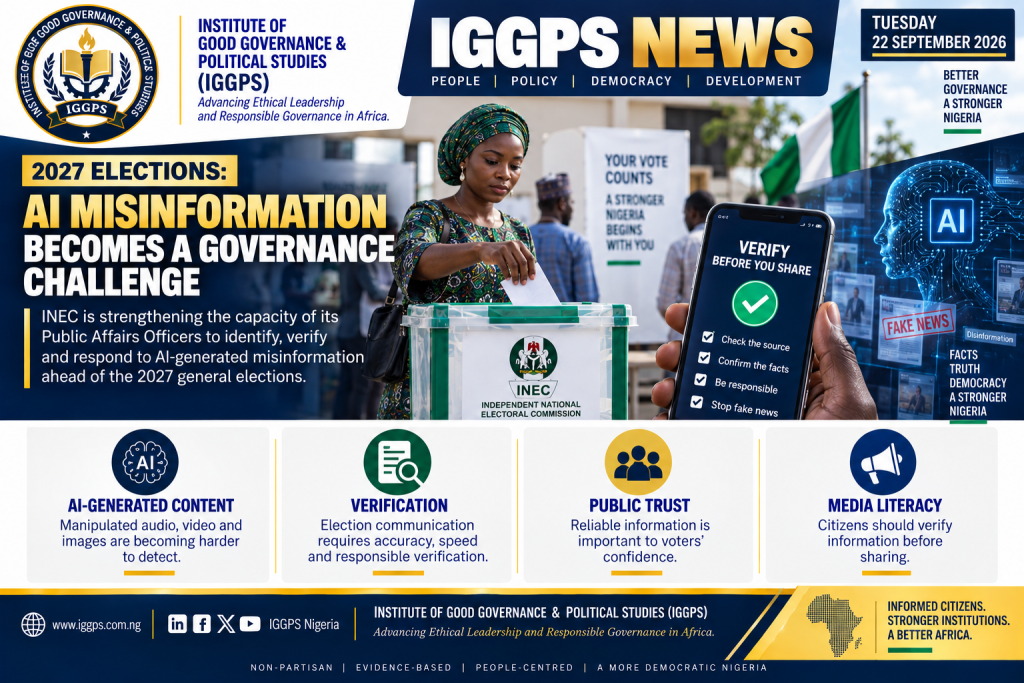

INEC Raises Alarm Over AI-Generated Content Ahead of Nigeria’s 2027 Elections
Nigeria’s electoral conversation has taken a new turn as the Independent National Electoral Commission (INEC) raises concerns about the growing use of artificial intelligence to create and distribute manipulated political content ahead of the 2027 General Elections.
INEC has warned that AI-generated misinformation is no longer merely a theoretical concern. The commission says manipulated videos, audio, images and other forms of synthetic content could complicate efforts to provide voters with reliable electoral information.
The development comes as political activity ahead of the 2027 elections intensifies. The African Democratic Congress (ADC) has separately raised concerns about attacks on opposition parties and called on INEC to demonstrate neutrality and protect the integrity of the electoral process. These are the party’s claims and should be distinguished from independently established facts.
THE GOVERNANCE IMPLICATION
The emergence of AI-generated political content introduces a new governance challenge: how can citizens distinguish legitimate political communication from manipulated information?
The issue extends beyond technology. It involves media literacy, institutional communication, platform responsibility, fact-checking, political-party conduct and citizens’ ability to verify information before sharing it.
At the same time, Nigeria’s broader institutional reform agenda continues. The National Assembly has transmitted the 1999 Constitution (Sixth Alteration) Bill 2026 to the 36 State Houses of Assembly for consideration. Among the proposals in the current constitutional review process is the State Police Bill, which seeks a framework for decentralised policing.
There is also renewed discussion about institutional independence and accountability. The AdvoKC Foundation has urged President Tinubu to assent to the Federal Audit Service Bill, arguing that stronger institutional control over the country’s supreme audit function would improve oversight of public expenditure. This is the foundation’s position, not an established finding about the effects of the bill.
IGGPS GOVERNANCE WATCH
As Nigeria approaches 2027, four issues increasingly intersect:
DIGITAL INTEGRITY — Can citizens identify manipulated political content?
ELECTORAL INSTITUTIONS — How can election administration maintain public confidence?
INSTITUTIONAL ACCOUNTABILITY — How effectively are public institutions subject to oversight?
CITIZEN PARTICIPATION — How can citizens make informed decisions within a democratic system?
The answers will depend not only on political actors, but also on the effectiveness, transparency and accountability of the institutions responsible for protecting democratic processes.