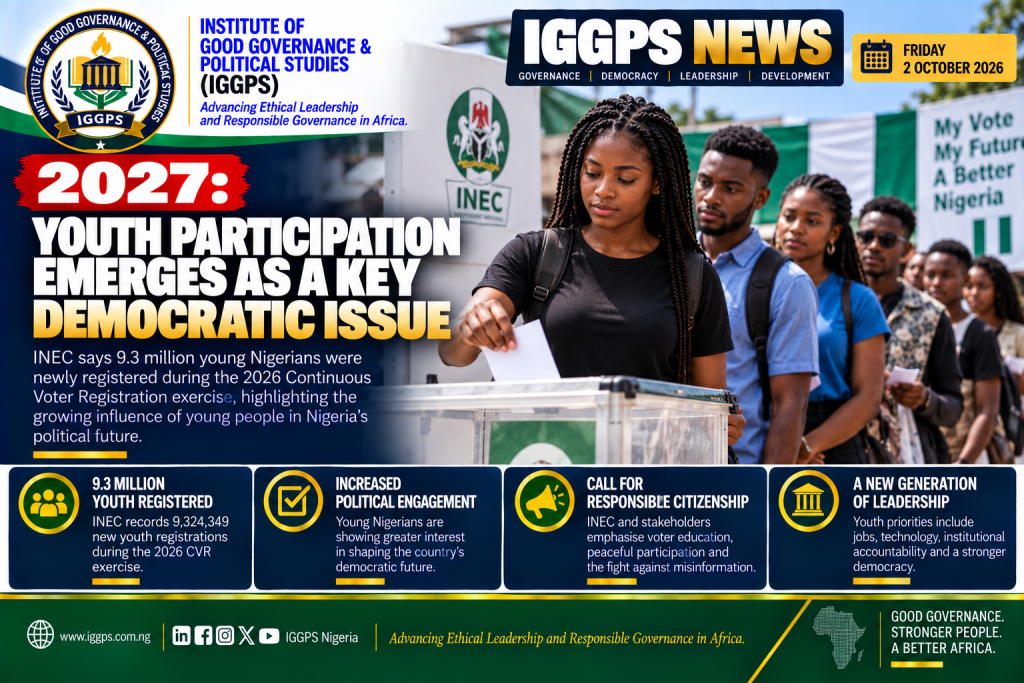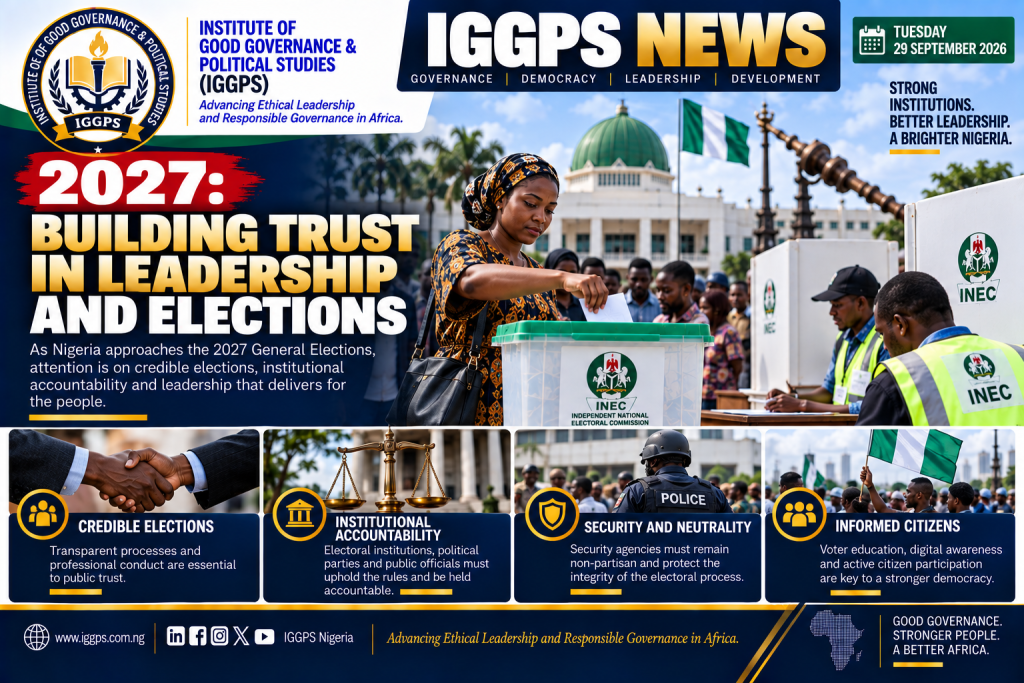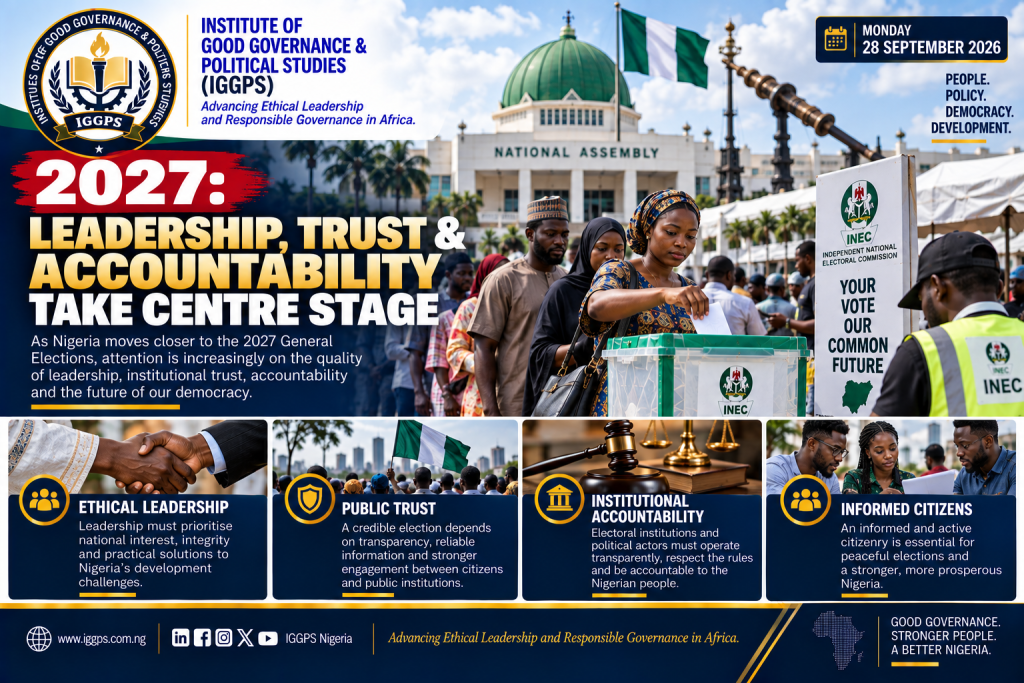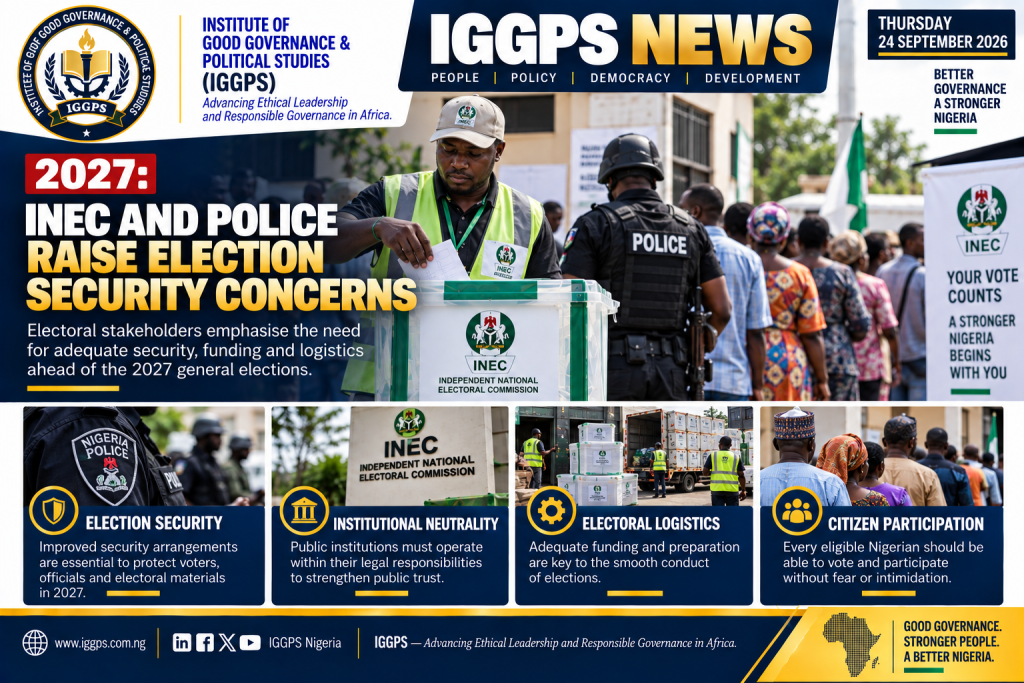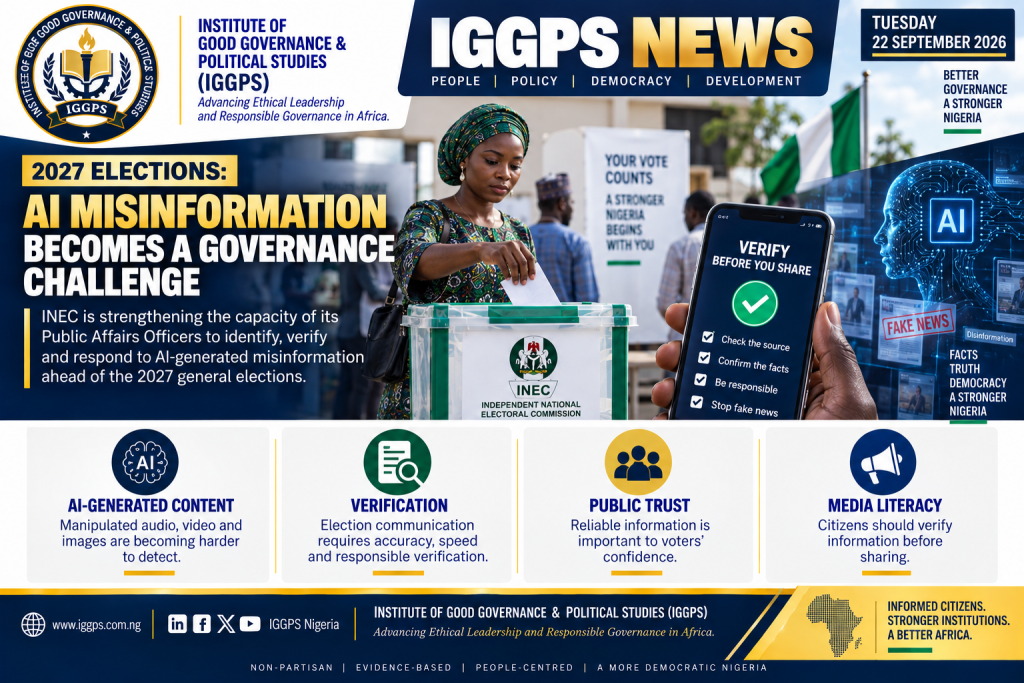

As Nigeria moves closer to the 2027 General Elections, the conversation about democracy is increasingly shifting beyond political campaigns and electoral competition to a more fundamental question:
Can Nigerians trust their democratic institutions?
This question has become particularly important as concerns over voter apathy, institutional credibility, accountability and citizens’ confidence in the electoral process continue to dominate national discourse.
On August 18, 2026, political parties and stakeholders signed a Peace Accord ahead of the 2027 presidential election, committing themselves to a peaceful and transparent electoral process. The National Peace Committee described the accord as part of efforts to encourage non-violent and issue-based political campaigns.
The development is significant because democracy cannot thrive where political competition consistently produces fear, violence, distrust and disengagement.
BEYOND THE BALLOT BOX
Democracy is much more than casting a vote every four years.
A functional democracy requires citizens to participate in public affairs, institutions to operate within the law, leaders to remain accountable and citizens to have confidence that their voices matter.
This point was emphasised at the recent Democracy Dialogue organised by the Goodluck Jonathan Foundation, where political leaders, scholars, jurists, civil society actors and democracy advocates examined the role of political parties and the judiciary in protecting democracy beyond elections.
The message is clear: elections are only one component of democracy.
The quality of governance between elections is equally important.
PUBLIC TRUST IS UNDER PRESSURE
Recent discussions across Nigeria have highlighted concerns about declining confidence in public institutions.
Catholic Church officials, speaking after the 2026 Annual General Meeting of the Justice, Development and Peace Commission, warned that growing voter apathy and declining public confidence could undermine the 2027 elections. They identified erosion of public trust in the electoral process as one of the country’s most serious democratic challenges.
This should concern every stakeholder in Nigeria’s democratic development.
When citizens believe that their votes do not matter, that institutions cannot be trusted or that government decisions are beyond public scrutiny, democratic participation begins to weaken.
The result can be political apathy, declining civic engagement and increasing distance between citizens and government.
STRONG INSTITUTIONS, STRONG DEMOCRACY
Good governance cannot depend entirely on the character of individual political leaders.
Nigeria needs institutions that are strong enough to function effectively, independently and transparently regardless of who occupies political office.
The judiciary, legislature, electoral institutions, public service, anti-corruption agencies and other institutions of government must operate within clearly defined constitutional and ethical frameworks.
Recent concerns raised by some lawmakers about constitutional governance, budget implementation, public expenditure, insecurity and institutional accountability further demonstrate the importance of strengthening democratic institutions.
A democracy becomes stronger when institutions are trusted to perform their responsibilities without fear, favour or political manipulation.
THE ROLE OF ETHICAL LEADERSHIP
Leadership remains at the centre of Nigeria’s democratic challenge.
The National Institute for Legislative and Democratic Studies recently emphasised the importance of deliberately investing in ethical leadership before individuals assume public office, arguing that democratic resilience and inclusive governance require leaders prepared to serve responsibly.
This is an important lesson.
Leadership education should not begin after a person wins an election.
It should begin much earlier—with character, civic responsibility, constitutional knowledge, public ethics, accountability and an understanding of the responsibilities that accompany public authority.
CITIZENS ALSO HAVE A ROLE
While government institutions and political leaders carry enormous responsibility, citizens are equally important to the success of democracy.
Citizens must participate responsibly, reject political violence, demand accountability, engage public institutions and make informed decisions during elections.
The Niger Delta Development Commission recently commenced a sensitisation programme encouraging students to register to vote and participate actively in the electoral process.
Civic participation must therefore become a continuous culture rather than an activity that begins only when elections are approaching.
IGGPS PERSPECTIVE
The Institute of Good Governance and Political Studies (IGGPS) believes that rebuilding public trust requires more than political promises.
It requires:
Integrity in leadership.
Transparency in governance.
Accountability in public office.
Respect for the rule of law.
Responsible citizenship.
Strong democratic institutions.
The 2027 elections should therefore be viewed not merely as another political contest, but as another opportunity to strengthen Nigeria’s democratic culture.
The question should not simply be:
“Who will win the election?”
The more important question is:
“What kind of democracy will Nigerians inherit after the election?”
THE ROAD TO 2027
The signing of the Peace Accord provides an important foundation for peaceful political competition, but an accord alone cannot guarantee public trust.
Trust must be earned through conduct.
Political parties must promote issue-based campaigns. Candidates must respect democratic rules. Institutions must act impartially. The media must remain responsible and citizens must remain vigilant.
Above all, Nigeria must continue building a political culture where public office is understood as a responsibility to citizens rather than a reward for political loyalty.
As the country approaches 2027, the responsibility belongs to everyone.
Democracy survives when citizens participate, institutions remain strong, leaders remain accountable and public trust is protected.
That is the governance Nigeria needs.
That is the democracy Nigerians deserve.