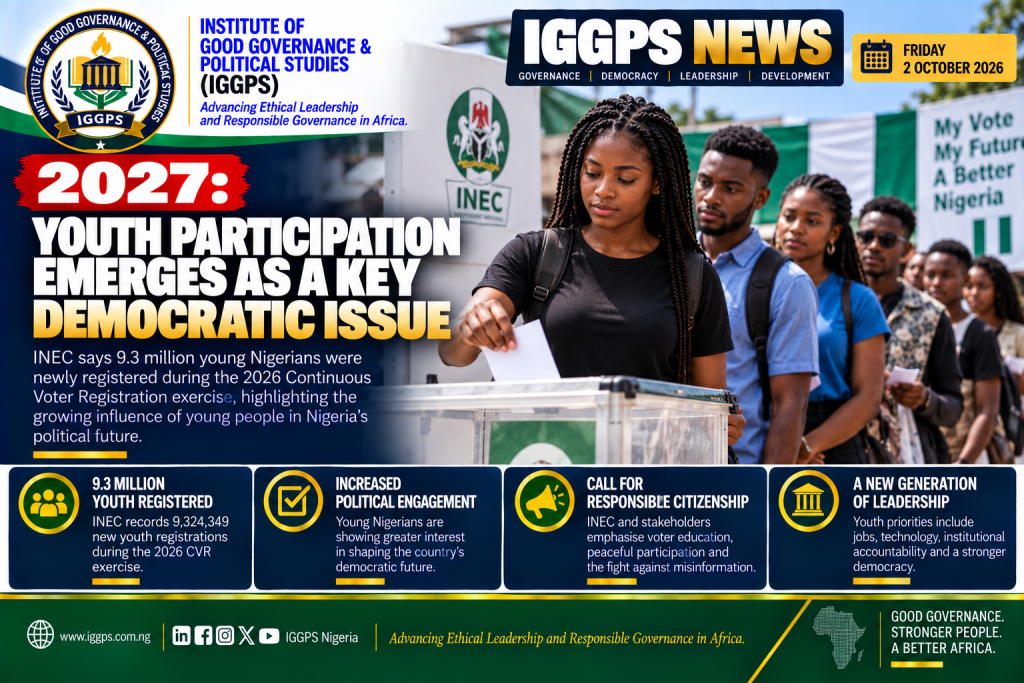

When the Independent National Electoral Commission (INEC) recently acknowledged that Nigeria’s voter register still contains the names of deceased citizens, many Nigerians reacted with concern. For some, it confirmed long-held suspicions about the integrity of the electoral process. For others, it raised a more fundamental question:
Can democracy thrive when citizens lose confidence in the institutions that safeguard their votes?
This issue should not be viewed merely as an electoral challenge. It is, at its core, a governance challenge.
Democracy Begins with Trust
Elections derive their legitimacy not only from ballots cast but also from public confidence that the process is fair, transparent, and credible.
Even if deceased persons are never used to cast fraudulent votes, their continued presence on the register creates doubt. In democratic systems, perception matters almost as much as reality. When citizens question the accuracy of the voter register, they begin to question the credibility of election outcomes themselves.
Public trust is difficult to build but easy to lose.
The Challenge Is Not Unique to Nigeria
Every democracy faces the challenge of maintaining an accurate voter register.
People die every day.
Others relocate permanently.
Some lose citizenship, while new voters become eligible upon reaching voting age.
The difference between strong electoral systems and weaker ones lies in how efficiently these changes are captured and reflected in the electoral database.
What Nigerians should demand is not perfection, but a system that continuously updates itself through reliable institutional coordination.
The Real Problem Is Weak Data Integration
INEC has explained that many deaths are never formally reported to the Commission, making it difficult to remove deceased persons from the register. The Commission says it is working more closely with the National Identity Management Commission (NIMC) and other agencies to improve the accuracy of the register.
This highlights a broader governance issue.
Nigeria’s public institutions often maintain separate databases that do not communicate effectively. Birth registration, death registration, national identity records, voter registration, passport records, pensions, and tax systems frequently operate in isolation.
Without secure and lawful data sharing between institutions, outdated records accumulate, reducing administrative efficiency and public confidence.
Beyond Elections: A Governance Issue
An inaccurate database does not only affect elections.
It can influence:
- Social intervention programmes.
- Pension administration.
- Population planning.
- National security.
- Healthcare planning.
- Revenue forecasting.
- National budgeting.
This is why voter register integrity should be seen as part of broader public sector reform rather than solely an electoral issue.
What Nigeria Should Do Before 2027
As preparations for the 2027 general elections gather pace, this moment presents an opportunity for institutional improvement rather than political blame.
IGGPS believes the following reforms deserve priority:
1. Strengthen Civil Registration
Births and deaths should be registered promptly and accurately across the country. An electoral register can only be as reliable as the underlying civil registration system.
2. Improve Inter-Agency Data Collaboration
Subject to the law and strong privacy safeguards, agencies responsible for identity management, civil registration, and elections should exchange verified information to help keep public records current.
3. Expand Public Verification
Citizens should be encouraged to inspect preliminary voter registers, report inaccuracies, and participate in claims and objection processes. Electoral integrity is strengthened when citizens become active partners.
4. Increase Transparency
Regular public updates on the number of records corrected, duplicate registrations removed, and deceased voters deleted would help build confidence in the clean-up process.
5. Invest in Technology and Capacity
Digital verification tools, biometric validation, and continuous data quality audits should become routine components of election administration.
Governance Is Measured by Public Confidence
The credibility of democratic institutions depends not only on legal mandates but on the confidence citizens place in them.
An accurate voter register is more than an administrative document. It is a symbol of institutional competence and democratic accountability.
As Nigeria prepares for the 2027 general elections, strengthening the integrity of the voter register should not be viewed as a political obligation to one party or another. It is a constitutional responsibility owed to every Nigerian voter.
When citizens trust the process, they are more likely to trust the outcome.